Notice: With the Laurelin server shutting down, our website will soon reflect the Meriadoc name. You can still use the usual URL, or visit us at https://meriadocarchives.org/
Loegenel

Loegenel "Taurondûr"
| Name | Loegenel |
|---|---|
| Status | Active |
| Occupation | Forester, gardener, scout, survivalist |
| Age | Very old |
| Race | Elf |
|---|---|
| Residence | Woodland Realm |
| Kinship |
| Outward Appearance |
Loegenel (Nandorin for "The pond in between"), also called "Taurondûr" (Sindarin for "Dark forester") is a silvan elf living in the Woodland Realm.
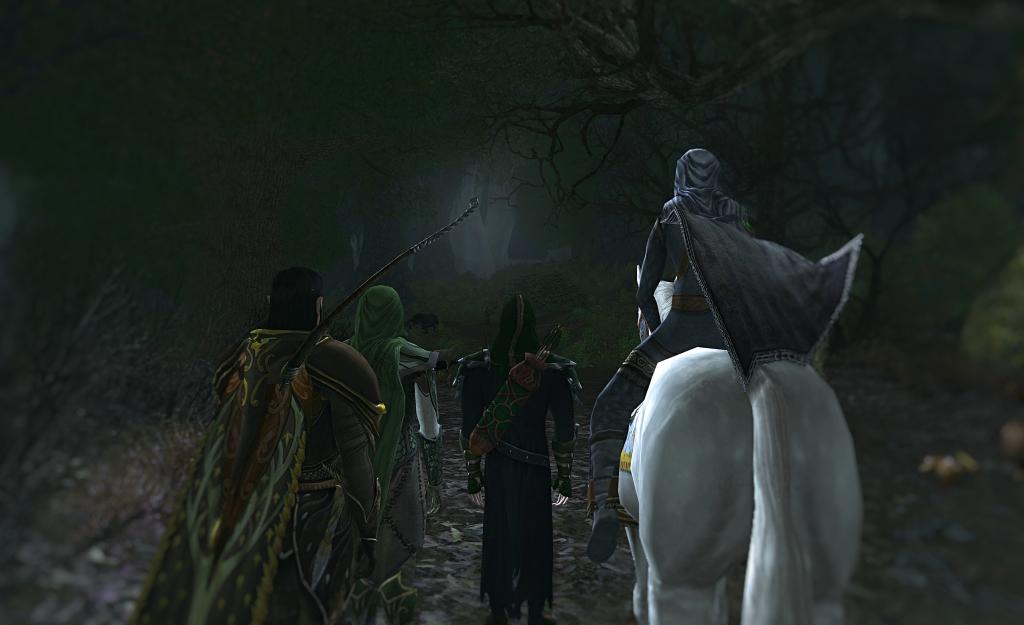
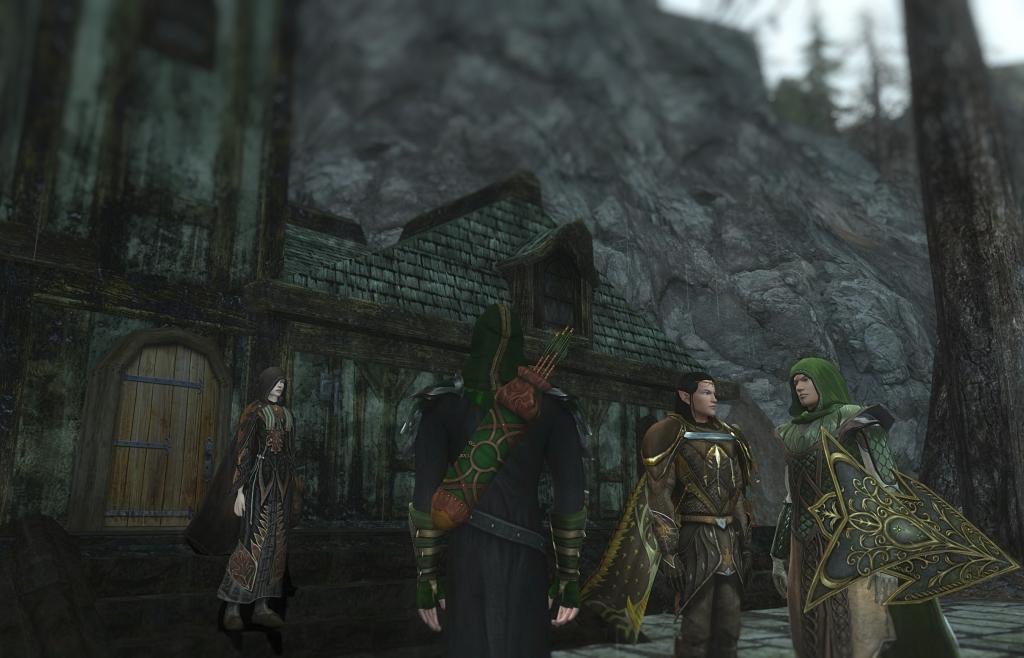
He loves wandering the forest twilight, and most of the time he is wearing garb made of leather and cloth, reflecting the dark green and brown colours of Greenwood the Great, now called Mirkwood. Carrying his hunting bow and a hunting knife, he does not appear particularly tall or massive but rather sinewy and lean, with broad shoulders and long legs. Most of the time, his movements are slow and reduced, safe in time of need where he can develop great peaks of speed and agility. With exceptional eyes, ears and nose he tends to constantly scan his environment, a silent observer taking constant notice of his surroundings.
He still remembers his mother-tongue (Nandorin), though there are few he can speak with in that language. Apart from Sindarin which is the official language of the Woodland Realm, he speaks fluently in the Common Tongue, though an accent may be heard by those who listen closely. He refuses to learn languages like Quenya or Khûzdul.
He can be found either within the great cavern city of Felegoth or in the vast forests of the Woodland Realm. A few times a year, he also travels to southern Mirkwood and the Brown Lands, and he has been seen in Lake-Town and the city of Dale as well.
|
|---|

Background
"The Nandor are the Host of Dan, the Wood-elves, the Wanderers, the Staff-elves, the Green Elves and the Brown, the Hidden People; and those that came at last to Ossiriand are the Elves of the Seven Rivers, the Singers Unseen, the Kingless, the Weaponless, and the Lost Folk, for they are now no more."
(JRR Tolkien, History of Middle-Earth / Morgoth's Ring)
______________________________________________________________________
Loegenel's memory stretches back to a time when his people used to live simple lives as hunters and gatherers.
Years of the Trees
During their great migration towards the west, the elves had encountered the mighty Hithaeglir. A part of them, lead by Lenwë (also called Dan) grew afraid of the icy peaks and difficult passages and did not continue the journey. These folk were called the Nandor (meaning "those who go back"), though neither did they go back to Cuiviénen nor did they stay nearby the mountains. Spreading through the lands east of the Hithaeglir, they populated parts of Middle-Earth that were later called Greenwood, the Brown Lands, Rohan and Gondor.

Loegenel's parents, outsiders in the beginning, were living in the large forest later known as Greenwood the Great. They called home to a place that later bore the name Sanalad (Sindarin for "Garden of Light"). A clear pond lay there, nourished by many wells, in midst of tall trees. There their only son was born, and they gave him the name Loegenel (referring to the life giving water in the centre of their home).
Not much from the childhood of Loegenel is known, but when he counted about eighty summers, the parents decided to abandon Sanalad one day. Nothing is known about their reasons, but it is said that dark creatures had begun to hunt the woods in that time, and the Nandor would rather abandon their homes and hide than stay and fight.
Wandering south, the family eventually met other tribes, and became part of a great clan that had decided to move west. For stories had reached the Nandor from King Elu Thingol who ruled a mighty realm in the west, in safety and prosperity.
Uniting under the son of Lenwë, an elf called Denethor whom they made their king, they moved west, taking a long and perilous road. Arriving to west of the Blue Mountains, they found rich and fertile woodlands with rivers and gentle lakes, mild winters and warm summers, called Ossiriand (Sindarin for "Land of Seven Rivers"). Settling there, they quickly made friends with the Sindar, who welcomed their new neighbours, calling them the Laegrim (Sindarin for "Green Elves").
And yet, in the years of Loegenel's youth, the peace of Ossiriand was interrupted, for the dark lord Morgoth in the icy north sent forth his armies to conquer the vast lands of Beleriand. That was when King Thingol Greymantle asked the Laegrim for aid, and the Green Elves answered his call. King Denethor himself lead the host from Ossiriand, but the armies of Angband reached them before they could unite with the Doriathrim. The Laegrim, lightly geared with wooden weapons that did not match the ironclad host of the Orks were driven back. Upon Amon Ereb they suffered terrible losses, and king Denethor was slain among many others.
That day Loegenel lost both his mother and father, and he hardly survived himself, hiding injured under thousands of corpses. Although the Orks were eventually defeated thanks to an united effort by the newly arrived Noldor in the north, Finrod Felagund in the south and Thingol in the east, the Green Elves retreated to Ossiriand, full of fear and grief. Never again they took a king, and they refused to play any further role in the wars of Beleriand. Thus, Ossiriand grew a secretive land, with the hidden singers of the Laegrim never leaving the forests.
First Age of the Sun
Loegenel, living upon the river Adurant, slowly getting over his loss, forgetting the horrors of a battlefield had grown very fond of the many trees, flowers and animals living in the woods. Caring for all living and growing things, he lived a life in service of the offspring of Yavanna.
So it came that after many decades he became the witness of a strange yet important event: Beren and Luthien appeared in Ossiriand to live the rest of their life together upon the island of Tol Galen. Some said that not only had this couple regained a Silmaril from the dark lord's crown in Angband, but had mastered fate by returning from the dead. Whether these rumours were true or not, Tol Galen was by that time called Dor Firn-i-Chuinar ("land of the dead that live").
When news came from the north about the assault upon Menegroth by the dwarves of Nogrod and the death of king Elu Thingol, Beren Erchamion prepared himself to waylay the thieves of the Nauglamir. Many of the Laegrim went with him, for Thingol had been a close ally and a loyal friend to the Green Elves from the beginning. Thus, the Hidden People left their lands for one last war.
Loegenel marched among the archers of the Laegrim, and his arrows found many Firebeards on that day. He saw the forest awakening and devouring the dwarven troops...
Little love he has felt for the dwarves ever after, and after the sack of Doriath by the sons of Fëanor he began to feel horrified whenever finding himself in the presence of a Feanorian warrior.
Second Age of the Sun
In the new world that emerged from the War of Wrath and the downfall of Beleriand Ossiriand had heavily changed its face. Sindar, Falathrim and Noldor settled upon the land, sharing it with the native Laegrim. Over the time, the Green Elves mingled with them, thus losing their unique ways of living, most of them even forgetting their language. And so the Lindi (Nandorin for "the singers) silently vanished from history, but their song and their knowledge about nature endured, enriching elven culture, filling forests and glades with melodies of the Hidden Folk.

In Lindon Loegenel lived for centuries, and under the rule of High-King Gil-Galad he served as royal gardener at court.
But eventually he grew weary of long robes, ceremonial feasts and concerts, of scholars and debates, of state affairs, politics and court gossip.
He laid down his duties and left Lindon, heading south and east.
Long he wandered through the vast forests of Minhiriath and Enedwaith, slowly returning to the life of the Laegrim once more. A few of the Onodhrim he met there, and through their common mission they slowly became friends. But in the woods he also met mortal men, ancestors of the folk that later was called the Dunlendings, and although there was not much trust in the beginning, eventually they grew accustomed to each other. The woodsmen after some while became aware of the great knowledge Loegenel possessed about flora and fauna of Middle-Earth. Teaching them, he soon became a figure of renown, and they called him Khas Wahan which meant "Father of the Forest" in their own language.
But other people had entered the forest in the south, tall, warmongering men with fair armour and mighty weapons. One after the other, they kept cutting down the trees, heading north. Loegenel tried to reason with them, but they took him prisoner and brought him to a great haven in the south, called Lond Daer.
For these men belonged to the people of Númenór, an island in the west, and great was their knowledge about buildings, ships, agriculture and warfare. Even greater though was their hunger for expansion, and the ever growing demand for more supplies was given expression with cruel methods. Slaves laboured at that haven, building ships for the númenórean armada and great siege weapons. Armies were mustered to conquer the lands of Middle-Earth, and upon a pretentious arena duels were fought to please the crowd.
Loegenel was brought before the commander of Lond Daer, Balakzîr, and he urged him to spare the forests and animals that lived within.
But his words were in vain, for Balakzîr desired nothing but glory and fame, and the friendship between the sea-kings and the elves had begun to decline.
Dismissing Loegenel, he made him a slave of Númenór, forcing the Green-Elf to labour among others, building fortifications around the haven.
Life and work upon Lond Daer was harsh, and few slaves survived more than five years in the cruel service of Balakzîr.
But Loegenel did not intend to spend the rest of his life in chains, and he managed to escape one night. Even though he was chased with hounds, they could not catch him, for their agility and skill in the wilds could not compare to the speed of the hardy and cunning Green-Elf.
Withdrawing to the north, Loegenel returned to the woodsmen. But over the years, the deforestation of Enedwaith and Minhiriath became a threat to all inhabitants of the great forests. With fire and steel the woods were destroyed, giving way to stone roads and farmlands. The Onodhrim had left the area, and the woodsmen tribes began to fight the foreign invaders. But even though they attacked Lond Daer several times, they could not win their desperate war. Slowly, the forest became a living hell for animals and humans alike, a place of ambush and skirmish.
Filled with grief and terror, Loegenel took the path to the southeast, and escaping the fighting he eventually reached Edhellond.
That haven had been a safe refuge for Sindar and Nandor alike, and Loegenel was united with his people once more. The Númenóreans by that time did not touch the elven haven, for their mind was directed to other places.
Of the events that took place later Loegenel knew not, for neither the deeds of the Gwaith-i-Mírdain nor the ruin of proud Eregion did affect Edhellond.
But after the emerging of Sauron as a new dark lord the elves, sensing a strange change upon Middle-Earth began to build ships and sail west.
The population of Edhellond grew thin, and those who did not pass to the uttermost west headed north, to the realms of Lórien and Greenwood the Great.
One stormy night the last ship of Edhellond was made ready, and Loegenel left the haven as well. For a while he dwelled in the Fangorn forest, for there some of the Onodhrim had withdrawn, avoiding war and turmoil. He also spent several years in the area southeast of the Greenwood, where some Onodrim had fashioned great gardens. But eventually, the Green-Elf traveled to the the realm of Lórien and was welcomed by the folk of Galadriel and Celeborn. Long he laboured there, pledging his service to the lady and the lord, and through unified work by all elven folk inhabiting that forest the Golden Wood over time became one of the fairest of all elven realms. Telain were built and ornate bridges, and fair gardens and peaceful glades were formed, and high upon the mighty Mallorn trees the great city of Caras Galadhon lay.
Little did Loegenel care for the downfall of haughty Númenór and the founding of Arnor and Gondor by the exiles, and when the last alliance was formed, he refused to take up arms. News of the massacre of king Oropher of Mirkwood and his warriors upon the battle of Dagorlad did reach Lórien a few years later, and fear and grief crept into Loegenel's mind again, and his heart desired once more the simple, peaceful life within the depths of the forest. At the dawn of the third age, he asked the lady and the lord permission to leave, which was granted. Leaving Lórien, Loegenel crossed the Anduin. Following the forest border, he reached the region southeast of the Greenwood, where the Onodrim once had fashioned marvelous gardens. Nothing but desolation and destruction Loegenel found there, for in order to hinder the approaching host of the Last Alliance, the armies of Mordor had ravaged and burned tree, field and hill alike, leaving nothing but a brown waste. A great array of gardens had thus vanished, and the area henceforth was called the Brown Lands. Shaken and shattered, Loegenel shed vain tears, tears that could neither bring back the beauty that once had been nor the gentle gardeners that had cherished it. But a great forest still stood strong - the Greenwood, and Loegenel entered the Woodland Realm.
Third Age of the Sun
Having entered the Greenwood, Loegenel began to seek the garden of Sanalad, his birth place. But despite of many years of searching, he could not find it. Instead, he began to fashion a new garden. Applying all knowledge he possessed, he organized water, soil and plants, combining it wisely with sunlight and wind. After many years, eventually a garden emerged, and Loegenel called it Sad Dínen (Sindarin for "place of silence"), remembering the marvelous Onodrim gardens that had vanished.
But southern Greenwood had changed. After the demise of king Oropher, most of the woodland folk had gone north with Orophers son, Thranduil who ruled the forest as new king. Amon Lanc slowly fell into ruins, and many elven settlements and castles lay empty. Few elves lived and wandered through the trees, and even they thought about crossing the Black Mountains (later called the Mountains of Mirkwood) to join their kin in the north. This was partly due to woodmen migrations. These tribes had the custom to wander through fields and forests and settle wherever they encountered better conditions and possibilities to live and thrive. From the beginning of the Third Age, several tribes had entered southern Greenwood, claiming its hunting grounds for themselves, thus pushing the few remaining elves to the north. Some of the woodsmen tribes left the forest, heading west, and some stayed. Some of the tribes had great leaders, men who possessed greater strength and knowledge than others. They held a close connection to the animals of the forest, and were sometimes called the Skin-changers. Loegenel, eager to maintain good relations with mortal men for the sake of all living and growing things, searched and befriended some of the Skin-changers. Thus, Sad Dínen was spared, and the Woodsmen did not interfere in Loegenel's labour.
But when a realm is forgotten, evil things may creep into the empty remnants, filling it with new life. After ten centuries since the beginning of the new age, a strange darkness began to infest southern Greenwood. Plants, trees and animals, growing sick and often dangerous slowly turned the whole area into a dark and sinister place. Almost all elves had left by now, and many woodsmen tribes forsook the forest, seeking a new beginning outside of the lingering twilight. Loegenel, feeling responsible for the well-being of his surroundings tried his best to hinder the spreading of the strange darkness. He examined trees and plants, tended for animals and explored the ruins of Orophers kingdom. But no answers he could find, and his resistance came to naught. One day, the garden Sad Dínen was discovered and attacked by a group of giant spiders, a breed that had not seen before in the forest. Loegenel, overpowered with ease, could not defend his work. Heavily poisoned, he was taken to a lair in the north, and stored like a peace of meat for several days. There, he would have met his demise, but he proved to be lucky once more. A hunting party, sent by king Thranduil encountered the lair. Killing most spiders and freeing the Green-Elf, they took the injured gardener to their halls. There he was tended and healed over time, and deeply grateful to his rescue he pledged his services to the king of the Woodland Realm, for in Thranduil he believed to see the bearer of all hopes and dreams for tree, plant and animal alike.

But things had started to look grim. A sickness, a corruption that came in many forms fell upon the forest, and year by year the Woodland Realm grew more sinister. After centuries, fair Greenwood had become Mirkwood, a forest of dimness and danger, and few dared to cross the Woodland paths.
But king Thranduil was not sitting idly upon his throne. He answered the threat with many actions. The core of the realm which consisted of many settlements, the most important of them being Felegoth the cave city was enlarged, strengthened and was kept guarded at all times. All forest around this core was ceaselessly tended and watched by the eyes of the Woodland Folk. The Silvan Elves also managed to maintain many different paths as well as the main forest road that went from west to east. The spider threat was answered by ongoing raids from time to time, though even with the elves destroying small and large lairs, the spawn of Ungoliant did not stop swarming the forest - a war that would not cease as long as the shadow of Dol Guldur lingered in the south. But of the south, the elves in northern Mirkwood were not certain, and many questions lay unanswered.
For many years, Loegenel laboured in Felegoth, tending to its gardens with many others, and after his talents were discovered he was appointed forester of the Woodland Realm. One of three hundred he was, and he was traveling much throughout the forest, tending to plants, trees and animals, fighting the creeping corruption wherever he could.
So the years were running, and over time Loegenel earned the Epessë Taurondûr ("Dark forester"), for not only did he labour in northern Mirkwood but dared to travel south, crossing the mountains. Neither a fighter he was nor a hunter, but at almost any point he was able to evade danger and stay unseen, for in his mind yet lingered the old knowledge of the Laegrim and the Nandor of old.
Many a seed he planted, and many a tree he cured from sickness. And yet he remained one of few, and Mirkwood covered a huge area. Thus, all he could achieve was to slightly slow the process of the corruption. Although he traveled south, he did not dare to approach the area around Amon Lanc, for a strange fear had awoken in his heart, a fear that he remembered well from bygone days and ages.
Many Elves felt the same, and the Woodmen later began to talk about a Necromancer inhabiting the great hill of southern Mirkwood.
With the Third Age coming to its end, a company of dwarves claimed Erebor in the northeast, and the dragon Smaug was slain. Rhovanion was in great movement, and king Thranduil left the Woodland Realm with a great host, aiming for Erebor. Though unwilling, Loegenel had no choice: he followed the order of the king, taking up arms. In the battle that followed, he served as a scout, and secretly he arranged things in a way that he did not kill any living being.
Back in the Woodland Realm, news came about the Necromancer withdrawing from Amon Lanc. But soon, Mordor awoke, and Mount Doom with it. Barad Dûr had been rebuilt, and after a while it was known among all Elvendom: Sauron had returned.
Amon Lanc, now called Dol Guldur, was heavily enlarged and fortified, and large armies of Orks and Men assembled around it, making southern Mirkwood on of the most dangerous places in all Middle-Earth. From there, raids were organized throughout all Rhovanion, and even Lothlorien was attacked several times.
That was when the rulers of the Golden Wood reacted. Lord Celeborn sent a host over the Anduin to keep the darkness of Dol Guldur at bay. In that time, Mirkwood awoke to a new era: Orks began to patrol the forest, and the amount of spiders in their lairs began to multiply. War was near, and the army of the Malledhrim occupied parts of southern Mirkwood. Being in contact with the Woodland Realm in the north, messengers and scouts were sent back and forth - but it was a perilous task, and the life expectancy of those that carried out these missions was low.
In order to cover up more areas in Mirkwood and thus tend to even more trees, Loegenel volunteered as a scout and messenger. His mission was to inform the Malledhrim of the dire situation in the north. Of the six scouts that left Felegoth, three were slain, and two went lost. In the year 3018 of the Third Age, Loegenel crossed the Mountains of Mirkwood again and for the first time since centuries entered southern Mirkwood, in that month being the only scout that had succeeded in his task.
Beholding the Malledhrim and Ork camps, the endeavours of the Golden Host and the activities of Dol Guldur, Loegenel realized: war was inevitable.
| Friends | |
|---|---|
| Relatives | None left alive |
| Rivals/Enemies |
| Loves | All living and growing things of Arda. Forest twilight. Caring for plants and animals. Watching the stars. Listening to the rustling leaves. Celebrations of nature and great feasts in general. Wine and merriment. Beornings. Ents |
|---|---|
| Hates | Creatures corrupted by the Shadow's influence. Orks, Spiders. Saving lost dwarves. Burrying dead dwarves. Foolish Dwarves in general (in his eyes, most dwarves are foolish). War and combat in general |
| Motivation | Restoration of Arda Unmarred. Taking care of the forest and all living and growing creatures within. Spreading the knowledge about flora and fauna of Greenwood the Great (by now Mirkwood) |
| Quotes | "Si loth a galadh lasto dîn" (Here flower and tree listen in silence) |
Loegenel's Adventures
| 10 Reasons To Despise A Noldo | 7 years 8 months ago |
| We Have Seen The Gardens Vanish | 8 years 6 months ago |