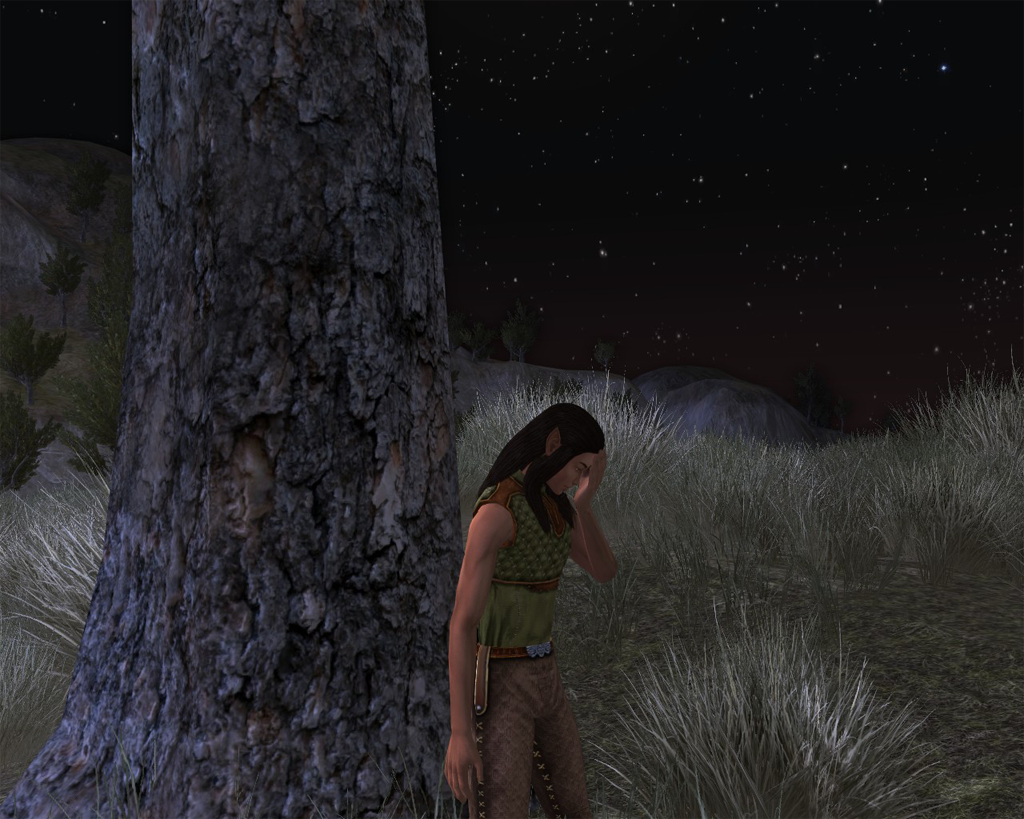
The moon had long since set when Feveren, seated under a lonely juniper on Foxden Heath with his back resting against its flaking bark, removed his journal from his pack. He opened it to the page he had marked with a fallen owl-feather, and in the starlight he read his last written words, cut short before from weariness. Frowning, he shook his head and turned the page to begin anew:
I have passed beyond the Eastway gate where I had a merry meeting with my very first halfling hobbit-friend, the marchwarden Bounder, Hildifons Took the Second. Ever will it lighten my heart to recall that strange and happy happenstance!
Now I find myself in the land that Master Dorongúr said was of old named Arassien, the Stag-lands,1 but today is called the Yondershire in the tongue of the Halflings Hobbits. For my wandering feet have brought me some two dozen2 leagues eastwards beyond the Lhûn, into the former realm of Men that was in the Second Age of the world named Arnor, the Northern Kingdom. But, so says the elf-lord, it was sundered threefold by quarrelling princes some two thousand years ago, and this western reach then became called Arthedain ere it was forsaken after the grievous war with Angmar whereof Mibrethil in Celondim told.
But aforetime, ere the days of Anor, Arassien was a great wild woodland that served Ereinion Gil-galad as his hunting grounds; thereafter Elendil the High King of Men used it likewise, and by his writ safeguarded the wilderness from settlement long after his mortal passing.3 But alas, the writ of the king did not endure...
* * *
* *
The same white stars glitter above my head as ever I have known, and the midnight Moon I watched sink into the west is still the slender silver crescent of yestereve. Yet around me the world has changed: I feel it in the earth, I smell it in the air, and I taste it in the water.4 Much that once was, is lost, for a long age has passed since Elves last loved this land. But still there is a wholesome air about it, for it is said much evil must befall a country before it wholly forgets my kindred5 (though when Master Dorongúr told me of the doom of fair Arassien his tale smote my heart, for I deem the wanton ruin of any glad greenwood is truly an evil deed!)
The earth of the halflings' hobbits' fields is rich and fruitful, and in the few forests that have regrown in the afteryears the glad trees send forth bright spring leaves, and merry birdsong rings amidst their branches. In the wet meads and along the grassy borders of the streams willows wet their feet, and fair white-tailed deer nibble the green grass upon the rolling hills. Doubtless the hobbit's fondness for their home has kept northern Arassien fair, but my heart tells me some bygone elven virtue yet endures.
But those woodlands now lie far behind me, together with the damp smell of moor and fen and the sweet apple-blossom of the hobbit-orchards, for my hidden path has taken me southwards along the scarp that skirts the Far Downs, and now a shadow clouds my heart! Never in my mind had I pictured a land without forests, for ever have I dwelt beneath the boughs of beech and oak and elm in Eryn Milbar, and on the lowlands of Harlindon many woods and copses gird the elven-farms; upon my journey hither through the lands east of the Blue Mountains ever have I wandered amidst the sighing trees, and even in the snow-clad realm of the Longbeards stands of tall pines and fir-trees whisper in the icy wind.
But now have I beheld with my own eyes a bleak scrubland where no green groves sing, and never does the sun shine through the fluttering leaves of woven boughs; no fronds of fern prick through the leafy mould to nestle between beds of mossy stone, nor fragrant woodland wildflowers bloom in the turf to sweeten the wind. Instead the strange scent of golden gorse blossoms fills my nostrils (but to my delight the purple heather smells like honey!)
Scattered over the barren hills stand forlorn junipers; some huddle together for comfort, but most are alone and friendless. Alas! there is no joy within their hearts, only a sullen sadness; for though they have lived but a hundred years and do not remember, they have tasted of the land's lament.
Grievous to my heart is the great sense of loss: my soles feel sorrow in the gritted earth and deep buried stone, and my soul feels an emptiness once filled with the glad spirit of the living greenwood, which is now no more than a bygone memory. And to my mind this land is too wide open; whereas the confines of the lofty dwarrow halls within the mountain's heart weighed heavily upon my mind, here the very sky seems to press down upon me. And as I gaze out over the rolling leagues of empty hills the thought comes to me that while I can see afar, so too can I be easily descried even in the moonless night; but though the trees are few the folk are yet fewer, and I have not seen a single soul since I skirted the hobbit-hamlet Hildifons named Tighfield (where Gwedal frolicked with the local Yonderboars!)
I bear Ereinion Gil-galad and his folk no ill will for hunting the gentle harts and hinds of Arassien, nor Elendil who did likewise thereafter. But those kings who in the afterdays despoiled the woods, not only defiled the green earth, they robbed it of its bliss. And but for farmland,6 it is said, whilst all the country where now lies the Hithershire (or so it is named by Hildifons, a Yonder-hobbit )7 were aforetime the great fields and orchards of the King of Arnor,8 long ere the wandering Hobbits were granted it for their abode. Needless was the wanton ruin of the greenwood therefore, while this former farmland stood forsaken and unused!
(It is the thought of Master Dorongúr that the farm-folk there dwindled because their sons were made to become soldiers for the king's strife with his brothers.)
I know little of the Secondborn, save for the tales of the Nauglamír in the Elder Days that were told to us by Selcheneb when we were but elflings in green-shadowed Eryn Milbar: of its finding by Húrin Thalion, and the sack of Menegroth thereafter; and its retaking at Sarn Athrad by Beren Erchamion, with the aid of my kin of old and the Onodrim of Ossiriand.9 Thus always I deemed most Men to be alike to noble Beren, for he was friend to birds and beasts,10 and a clan-friend of my folk when he dwelt apart with Lúthien Tinúviel his wife at Tol Galen Dor Firn-i-Guinar, amidst the Adurant.11 But, alas, I deem I was sadly mistaken.
To my mind it seems that most Men are unwilling live in accord with the living earth, and it is their will only to dominate and misuse it for their own ends while they live out their brief mortal lives. But the thought comes to me that it is indeed this mortal aspect of Men that makes them selfish and heedless (and perilous!), for they are not forever bound to Middle-earth12 but die and leave the world, and therefore need not abide with the aftermath of their greedful deeds.
Nevertheless, the more I learn of the Usurpers13 the more my heart misgives me, and the less I desire to meet their kind!
* * *
1. "The Yondershire is an area in the north-western part of the Shire. In the time of Gil-galad, this area was called Arassien, the Stag-lands, for the High King and his people often hunted the great harts and hinds that grazed here."
- LotRO Wiki, "The Yondershire"
2. S. ýneg (cardinal number) “twelve, two sixes” (T. yúnecë, Q. yunquë)
("The Eldar preferred to reckon in sixes and twelves as far as possible." - LotR, Appendix D)
3. "Originally covered in woods that served as hunting grounds for Gil-Galad and, later, Elendil, it became part of the province of Arthedain when Arnor was settled but preserved as wilderness by writ of the King."
- LotRO Wiki, "The Yondershire, Lore"
4. Adapted from Galadriel’s opening monologue in New Line Cinema's The Fellowship of the Ring (2001)
5. The Fellowship of the Ring, "The Ring Goes South"
6. "Later kings, however, razed the old forests for farmland: some woods later grew back but much of it remains open country, heather-covered moors and fields of rich tilth that support such crops as barley, hemp and cotton."
- LotRO Wiki, "The Yondershire," Lore"
7. "Have you heard the rumour that Yonder-hobbits are more prone to 'Tookishness' than our cousins in the Hithershire, more likely to give in to wandering and adventuring? Well, they are true, but wait until you hear what our folk have to say about hobbits from the Shire Proper, as they call it!"
- Adamanda Took, LotRO Wiki, "Quests of Yondershire, Deed Lore"
8. "The land was rich and kindly, and though it had long been deserted when [the hobbits] entered it, it had before been well tilled, and there the king had once had many farms, cornlands, vineyards, and woods."
- The Lord of the Rings, "Prologue, Concerning Hobbits"
9. "Now word went swiftly among the Elves of Ossiriand that a great host of Dwarves bearing gear of war had come down out of the mountains and passed over Gelion at the Ford of Stones. These tidings came soon to Beren and Lúthien; and in that time also a messenger came to them out of Doriath telling of what had befallen there. Then Beren arose and left Tol Galen, and summoning to him Dior his son they went north to the River Ascar; and with them went many of the Green-elves of Ossiriand. [...]
"And as they climbed the long slopes beneath Mount Dolmed there came forth the Shepherds of the Trees, and they drove the Dwarves into the shadowy woods of Ered Lindon: whence, it is said, came never one to climb the high passes that led to their homes."
- The Silmarillion, "Of the Ruin of Doriath"
10. "Thereafter for four years more Beren wandered still upon Dorthonion, a solitary outlaw; but he became the friend of birds and beasts, and they aided him, and did not betray him, and from that time forth he ate no flesh nor slew any living thing that was not in the service of Morgoth."
- The Silmarillion, "Quenta Silmarillion, Of Beren and Lúthien"
11. "Then Beren and Lúthien went forth alone, fearing neither thirst nor hunger; and they passed beyond the River Gelion into Ossiriand, and dwelt there in Tol Galen the green isle, in the midst of Adurant, until all tidings of them ceased. The Eldar afterwards called that country Dor Firn-i-Guinar, the Land of the Dead that Live; and there was born Dior Aranel the beautiful, who was after known as Dior Eluchíl, which is Thingol’s Heir. No mortal man spoke ever again with Beren son of Barahir; and none saw Beren or Lúthien leave the world, or marked where at last their bodies lay."
- The Silmarillion, "Quenta Silmarillion: Of the Fifth Battle: Nirnaeth Arnoediad"
12. "It is one with this gift of freedom that the children of Men dwell only a short space in the world alive, and are not bound to it, and depart soon whither the Elves know not. Whereas the Elves remain until the end of days, and their love of the Earth and all the world is more single and more poignant therefore, and as the years lengthen ever more sorrowful. For the Elves die not till the world dies, unless they are slain or waste in grief..."
- The Silmarillion, "Quenta Silmarillion: Of the Beginning of Days"
13. "The Atani they were named by the Eldar, the Second People; but they called them also Hildor, the Followers, and many other names: Apanónar, the After-born, Engwar, the Sickly, and Fírimar, the Mortals; and they named them the Usurpers, the Strangers, and the Inscrutable, the Self-cursed, the Heavy-handed, the Night-fearers, the Children of the Sun."
- The Silmarillion, "Quenta Silmarillion: Of Men"
 |
xxviii |
 |