Thibinoriel and Eregiel occasionally enjoy long strolls through the Golden Wood of Lothlórien. On one occasion they came by chance to the hill of Cerin Amroth.

It was here that Amroth, a Grey-elf, built his home among the boughs of a great mallorn in the manner of the Galadhrim. Aragorn, Chieftain of the Dúnedain of the North, and Arwen Undómiel, granddaughter of Lord Celeborn and Lady Galadriel, pledged their troth at the base of a great mallorn.
Eregiel and Thibinoriel sat on the exposed roots of this great mallorn to refresh themselves from their long walk. They enjoyed bites of dried fruit and nuts with sips of wine made from grapes grown in Lothlórien's vineyard. The sisters occupied themselves in conversation as well. It began in light-hearted manner, but soon turned more serious.
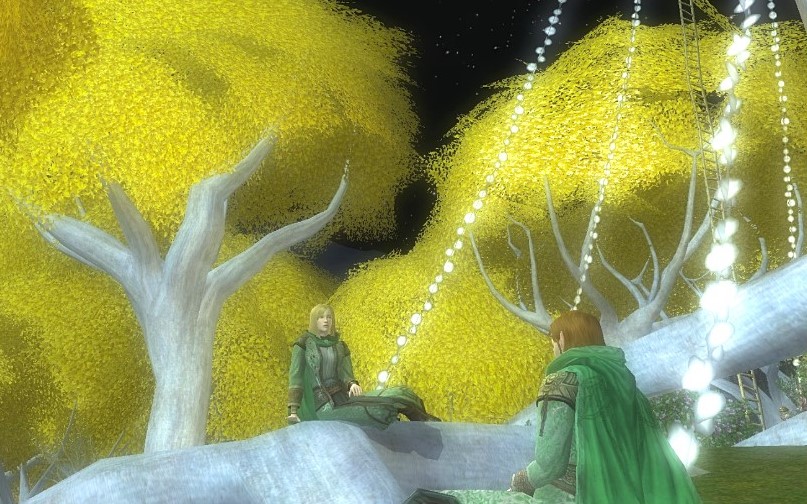
'Nésa,' Eregiel began, 'if you had not met Celebthondir before we left Aman, would you have considered marrying a Man in the days after we had come to Beleriand?'
'This is a strange question, nésa. May I ask what brought this to your mind?' Thibinoriel replied.
'I hope you are not avoiding my question!' said Eregiel with a laugh.
'No, not at all!' answered Thibinoriel who laughed in return.
'I was thinking about the wedding at Midsummer between Elessar and Undómiel,' said Eregiel.
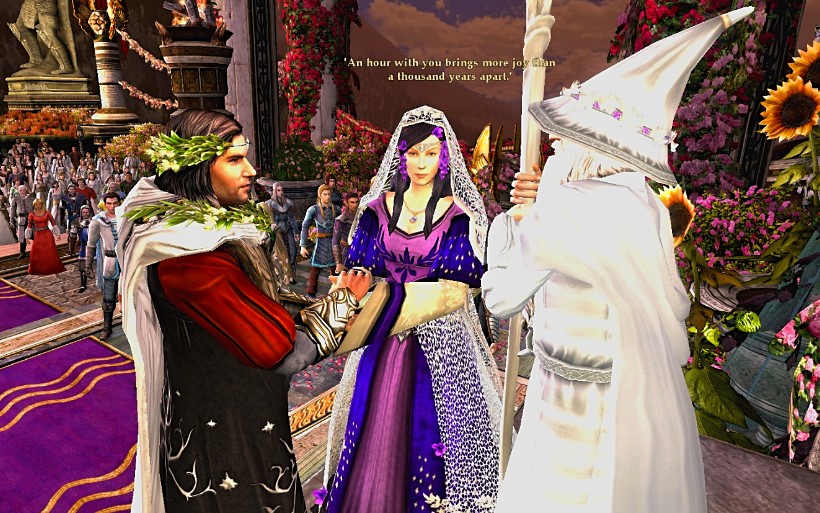
'Ah, the wedding! It was very beautiful, yet exceedingly poignant,' replied Thibinoriel.
'It was indeed,' agreed Eregiel.
Thibinoriel thought for a moment before posing a question of her own, 'Do you know what I see when I look upon a Man?'
'An uncouth brute?' answered Eregiel immediately. She laughed to hear herself speak so frankly. Thibinoriel laughed also.
'You would not be thinking of Bolgi,' asked Thibinoriel, 'that horrible Dunlending chieftain who took us hostage, would you?
'Yes, of course I am thinking of Bolgi,' answered Eregiel. 'It upsets me to even hear his name!'
'He was indeed very unpleasant,' Thibinoriel agreed, 'yet he was only a servant of the traitor Curunir. One of the Istari should have known better!'
Eregiel became nearly overcome with sadness. 'Perhaps it is best we not recount that horrible incident,' she implored.
'Agreed,' said Thibinoriel. 'When I see a young Man, presumably in his prime, I very often perceive someone who is little more than a foolish child.'
'A child, nésa?' asked Eregiel.
'Yes, a child,' answered Thibinoriel. 'Consider Elessar: he is the best of all Men, is he not?'
'He is,' agreed Eregiel, 'or at least Undómiel believes he is.'

'And nearly all would agree with her,' said Thibinoriel. 'Yet, Elessar the Dúnadan, who has not even reached his one-hundredth year, is already showing signs of aging.'
'Yes, nésa, but he has led a very difficult life full of great toil and hardship,' declared Eregiel. 'Through his labours he hoped to prove himself worthy of marrying Lord Elrond's daughter.'
'At Elessar's age we Eldar have not yet come to adulthood,' stated Thibinoriel. 'Moreover, many more seasons will pass before one of the Eldar attains the fullness of maturity and wisdom'
'Yes, nésa, that is very true,' conceded Eregiel. 'But what of an older Man?'
Thibinoriel answered slowly and very deliberately. 'When I look into the eyes of a Man who is white-haired, wrinkled, and bent with age I see death.'
'Death!' said an alarmed Eregiel. 'Your words chill me to the bone, nésa.'
'Alas, yes,' Thibinoriel answered solemnly. 'Whether a Man is cruelly slain, suffers mishap, is stricken with disease, or succumbs to the passing of time, this is his fate.'
She continued a moment later saying, 'Your question essentially asks whether I would marry someone who in my eyes is still a child in terms of his development.' She paused a moment for emphasis. 'Nay, I cannot see any circumstance where that may have happened.'
'But what of Beren and Lúthien?' asked Eregiel.

'Their union was exceptionally rare, and was fated by the Valar, or so thought Queen Melian,' replied Thibinoriel. 'Do you remember what King Thingol said to Beren at their meeting?'
"Who are you that come hither as a thief, and unbidden dare to approach my throne?"(1)
'I do,' Eregiel answered. 'I recall also King Thingol naming Beren "baseborn mortal".(2) But it is not unusual for fathers to be protective of their daughters.
'Particularly so when the father is a king,' declared Thibinoriel.
'Yet,' replied Eregiel, 'there is no record that King Turgon of Gondolin objected to the union between his daughter Idril Celebrindal and the mortal Tuor.'
'That Tuor came to Gondolin as a messenger clad in arms and armour that Turgon himself had left in Vinyamar by command of Ulmo, Lord of the Waters, doubtless eased his acceptance,' asserted Thibinoriel.
'Doubtless,' agreed Eregiel. 'Without the union of Tuor and Celebrindal there would be no Eärendil, and without Eärendil there would be no Elrond, and without Elrond there would be no Arwen.'
'Your argument is very compelling, nésa,' said a smiling Thibinoriel, 'but our father is neither king, nor prince, nor lord. Unlike Arwen Undómiel, Idril Celebrindal, and Lúthien Tinúviel, it is not my fate to change the course of the Children of Ilúvatar, whether Firstborn or Second, here in Middle-earth. It is, however, my great joy to call Celebthondir my husband, a blessing to call you and Calentauriel my sisters, and an honour to serve the House of Finarfin. I am content with my fate.'
Thibnoriel paused for a moment before finally asking, 'Nésa, have I answered your question?'
'Indeed you have, nésa, and very thoroughly,' replied Eregiel. 'I should have expected no less from you.' She smiled with amusement.
'I am also most blessed to call you and Calentauriel my sisters,' Eregiel added, 'and honoured to serve the House of Finarfin with you both. I cherish the home we have made in this Middle-earth, but I long to be reunited with my husband in Aman. Then I, too, shall be content.'
A moment of quiet reflection followed.

'It appears that our conversation has come full circle,' observed Thibinoriel.
'So it has,' agreed Eregiel.
The sisters enjoyed a last sip of wine before packing up their things for the return walk back to the City of the Trees.
~The End~
(1) J.R.R. Tolkien, 'The Silmarillion', Of Beren and Lúthien
(2) ibid.