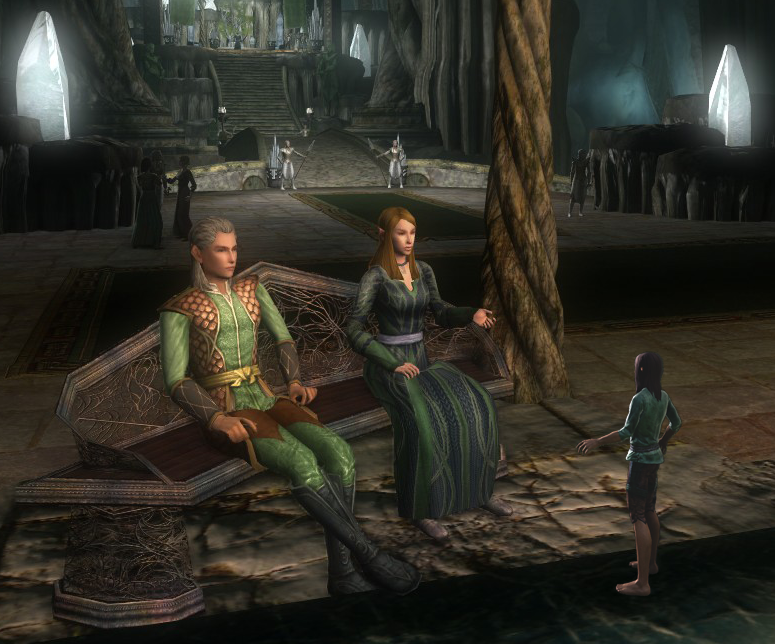
Methlegel stood smiling up at the faces of the Green-elves who stood around him in the glade; they were gathered there together in joyful celebration of the eleventh year since his begetting, and thus for ten years now had he sung and danced beneath the stars, Sun and Moon. For the Laegil this was indeed a day of joy, for the boy was the last elf-child to have been born into their clan, and would ever be; for it had been resolved by their Elders that in these fading days of the Elves in Middle-earth, it would be unkind to bring new souls forth into a world that would be soon (as the long years are reckoned by the Elves) forsaken by their kindred.
That day of departing would be a day of sadness, but this day was a day of gladness: wine flowed and songs were sung; the joyful music of flute and harp rose high above the tree-tops, and the Green-elves danced beneath the autumn sickle Moon. Then Methlegel leapt up upon a fallen tree trunk, and in his high clear voice called out:
'I have some words to say while all my kin and friends are gathered here together...' , and the Elves broke off their merry-making and bent their ears to hear him. The small elf-boy took a deep bracing breath. 'I am grateful to have been born among such merry folk; to be loved an cherished by every one.' He paused to bow deeply before them. ' As Methlegel I am known to you, but today I would choose a new name.'
At this there came a nodding of many heads, for in the First Days of the Elves' Awakening at Nen Echui, the Unbegotten had chosen their own names, and in the long uncounted years hence it had been their way to thus do likewise. But while the Amanyar aforetime had the rite of Essecilmë[1] for their children when they were deemed fluent in their tongue and wise in their knowing of themselves, the Úmanyar had no such custom.[2]
The boy went on. 'My father took me with him yesterday to see for my first time the Halls of the Elvenking, our liege lord...' and Echeleb, his father's father, scoffed loudly at these words, for though he abided the rule of the Iathrim over the Woodland Realm, he had little love for them. Methlegel smiled at him and continued, '... and thither the stiff-necked Sindar of his court looked upon me without delight and called me 'Laegelion' in their tongue; and when I asked them of its meaning, they mocked my Silvan speech and told me it means "son of Green-elf", for in their eyes I was naught but another wild and unworldly urchin of the greenwood. And while I deem their naming of me thus was done in scorn, I am proud to be my father's son.' He gave an impish grin. 'Thus I would take their given name in merry jest, but in the form of our Danwaith forefathers so to esteem our line, and will henceforth with pride be called Legelion!'
Thereat the gathered Elves laughed aloud in their mirth, and raised up their goblets in praise; and laughing too, the boy sprang from the mossy log and embraced his father standing there, his arms clasped tightly around Gellin's knees.
* * *
Amdirren drew her small son down onto her lap; with one arm she cradled him around his slim waist, and her other hand held his slender feet, and he giggled and wriggled his toes as she lightly tickled their soles.
'Ai, ionneg,' she said, 'my little son no longer. For today you have taken a name of your own choosing; how you are growing!'
Legelion smiled and said, 'My loving mother, I shall always be your little son! Ever shall I be but a seedling in the green shadow of your high boughs.'
Together they laughed, but then her face became grave. 'Dear one,' she said, 'I fear for this dislike shown to you by the Sindar, and I distrust the thought behind their unfriendly words.'
'Think not of it,' the boy grinned, 'I deem they are but one pair of haughty upstarts, and not all the Grey-elves think alike.'
'Perhaps,' his mother agreed. 'But was there aught that you felt ere their mockery? A warning in your heart, maybe?'
Seeing her mood, her son knew that she was in earnest and that this was no time to jest. He closed his eyes in thought as he answered her slowly, 'Mayhap... for though I knew them not, I had for a brief moment before they spoke to me, the thought that these strangers were far above us in skill and wisdom; that I should humbly submit to their might. But my heart gainsaid the thought forthwith, though in that moment I deemed it was my but a wounding of my pride.' He frowned, 'But nary a word had yet been spoken... how could my pride have felt any hurt?'
Amdirren's eyes flashed angrily. 'Nay, my son,' she retorted, 'it was not your pride.'
'What then?' he asked, astonished by her reaction, for rarely had he seen her brought to wrath.
'You have marked when I speak voiceless with your father, mind to mind?' she answered him.
'Aye,' replied Legelion, 'only your thoughts go to and fro. I have tried this with the woodland rabbits, but to no avail; though I oft hear the voices of the trees within my heart.'
His mother suppressed a smile. 'This is not the same, for it is a skill only of the Eruchîn; those who are souls embodied.'
'My friends, the rabbits, have no souls? Nor the beech and oak? Alas!' exclaimed the boy.
Now she could not help but smile. 'Nay, she said, 'they are unlike us. But what you endured is alike to my communing with your father. For what you felt was indeed the sending of thought, but it was ill-done for it was a deed of stealth and mischief. But there is a skill that will aid you, which I shall show you.'
'You are going to teach me thought-sending?' he asked, his eyes wide.
'Nay,' she answered, and his face fell and the light within his eyes dimmed. 'Although your mind is ever flourishing, you are yet too young, I deem, to learn that skill. However, what I will show you now is akin to it, and you are old enough to learn this at the least. Heed now my counsel, for it would be folly to not to learn this lore.' She well knew that the word "lore" would appeal to his keen but wayward mind; and indeed, he swiftly moved to sit upon his heels before her, his eyes now bright and eager.
* * *
'Cethron,' Amdirren began, 'or as I should now call you, Legelion...'
'O nay, Mother, I beg you! That is the name you gave me, thus shall it ever be the name you call me by!'
'Very well, then, my small Seeker. I can send my thought to your father, and even if he is not listening with his mind, yet will he hear my thought if his mind is open. Now this openness is the common state of being for any mind that is not otherwise preoccupied.'
'My mind was open then, in the Halls of the Elvenking?'
'I know your mind, my dearest child, and when you are in wonder at all around you it is like a fluttering butterfly in a flowered meadow! And you, dear one, are unaware of evil and thus unwary of it, for your young heart is honest and untainted thereby. And this proved to be its strength, for at its warning you closed the door of your mind to another's trespass.'
'I did? But I do not follow your meaning. My mind has a door?'
'Indeed. A door that, like any other, can be opened or closed. One of the Sindar that crossed your path hoped, by stealth, to implant his own ill thought within your open mind: the thought that you were unworthy. But you heeded the warning in your heart and unwittingly closed your mind to him and thwarted his mischief.'
Legelion gave a cheer. 'O! Good for me!' he cried.
'Aye, Cethron, good for you,' his mother smiled.
'But you said I was going to learn lore... what lore is there to simply trust in my heart?'
'You unwittingly closed your mind, but it may be closed willfully against one mind, or many, or all.'
'It can? How so?'
'With your will you can make an impenetrable barrier that none can breach.'
'Like wall? Oh, I see now: a wall with a door therein! And none can breach it? None at all?'
'Save One only.'
Legelion frowned. 'Who now?'
'No mind can be closed against Eru.'
'Eru? Wherefore would He wish to enter my mind?' he laughed.
'Jest not,' admonished his mother sternly. 'Should He have a message for you that He deems you must heed, you shall hear it.'
Unabashed, her son asked, 'A message for me? But that seems to me unlikely; does he oft speak thus to his vassals?'
'Of that I know not,' she admitted, 'but I have heard tell in tales of visions and dreams given to some by the Rodyn.'
'Truly? To whom? And what tales are these?' he asked, now intrigued.
'Alas, my ever inquisitive Seeker, verily I cannot now recall, for they were told to me by Rodon and Silivreneth your foremothers when I was but a child and dwelt briefly in Harlindon, ere they crossed the Sundering Sea and the remnant of our kin removed hither to Rhovanion.'
'Alas that we have lost much lore and wisdom with the departing of our forebears,' he said sadly.
'Be not forlorn,' said Amdirren. 'For now is the moment to fix your keen mind upon the skill which I have promised to impart to you. Hearken carefully now...'
* * *
Some hours afterwards, mother and son sat together sipping small cups of wine to restore themselves.
'You have done very well, dear one. But in our lesson I saw your thoughts concerning your name-choosing, and that Methlegel, your given name, brings you much unquiet. I knew not that this troubled you so,' said Amdirren.
'Verily it does, but I had not the heart to burden you and my father. For my name is ever a remembrance that I am the last of my kin, the very end of its line. I hope my choosing a new name did not affront you or my father,' her son answered.
'That is indeed a heavy burden for your small shoulders to bear. But know this, your father and I did not choose that name for you.'
'Not you?' the boy exclaimed.
'Nay, it was our wish to name you in honour of your fallen brother, Amdiran, who was to us our long hope; you were to be our final hope: Amdirvethen.'
'Amdirvethen...' he softly said in wonderment, 'this is a fair and wholesome name; had I but known it would have been my chosen name instead.'
'But it would not have been of your own choosing. And your new name gives your father much pride, for it honours him more than you know.' She smiled brightly. 'Besides, you named yourself in jest, and a merry one we deem; thus is it far more fitting for your light heart and joyful nature!'
Legelion's wide smile became an even wider yawn.
'And now you are weary; it is time for you to rest lest you swallow your own head!' his mother commanded.
'But...' he began.
'One "but" will I allow, and then you must sleep.'
'But who was it that named me Methlegel?'
'It was the notion of Echeleb Túbeng, your father's father,' she sighed. "Now sleep well, my little son! May the stars keep watch over you and Lórien grant you sweet dreams,' she said as she left the room.
At that Legelion crawled sleepily atop the soft pillows piled beside him on the floor of their abode, and as he closed his eyes he wondered whether he was now also old enough to ride a horse, and his thought drifted to how this might be achieved...
* * *
[1] "Later there was another ceremony called the Essecilme or 'Name-choosing'. This took place at no fixed date after the Essecarmë ['Namemaking'], but could not take place before the child was deemed ready and capable of lámatyávë, as the Noldor called it: that is, of individual pleasure in the sounds and forms of words. The Noldor were of all the Eldar the swiftest in acquiring wordmastery; but even among them few before at least the seventh year had become fully aware of their own individual lámatyávë, or had gained a complete mastery of the inherited language and its structure, so as to express this tyávë skilfully within its limits. The Essecilmë, therefore, the object of which was the expression of this personal characteristic, usually took place at or about the end of the tenth year." *
- Morgoth's Ring, 'Laws and Customs among the Eldar'
* ((Although Legelion is not counted among the Ñoldor and the Silvan Elves are considered a "lesser" Kindred, he is a precocious child who delights in words.))
[2] "In the period of Exile the Noldor modified their use of these terms [Kalaquendi and Moriquendi], which was offensive to the Sindar. [...] The old distinction, when made, was represented by the new terms Amanyar 'those of Aman', and Úamanyar or Úmanyar 'those not of Aman'..."
- The War of the Jewels, Quendi and Eldar
[3] Kudos to Ósanwe-kenta: ”Enquiry into the Communication of Thought” published in Vinyar Tengwar #39 (July 1998)
 It should be noted that this tale is set in the 2975th year of the Third Age, when Legelion was but ten years of age; also that these anecdotes are not in strict chronological order
 |
x |  |