Herewith is the long history of my kin as told to me by my father's father (and my own brief part in this tale of years):
 Now it came to pass that in the 1105th year of the Trees in the First Age of Arda, when the Eldar heeded the summons of the Valar and set forth on the Great Journey westwards from Nen Echui to Belegaer, they passed through Eryn Galen and came to the Hithaeglir. There were those among the Teleri who feared to cross those high mountains and, led by Lenwë (whom they called Dân), they repaired southwards into the vales of the River Anduin; thus they came to be called the Nandor.
But long thereafter orcs and other foul creatures of Morgoth began to harry them, whereat Denethor son of Lenwë -- hearing of the power and protection of King Thingol in Doriath -- led a host of the Nandor westwards over the Hithaeglir and the Ered Luin; there, ere the dawning of the First Age and the rising of the Moon and Sun, they came to Ossiriand and were welcomed as kin by the Lord of Beleriand and given his leave to dwell in those green unsullied lands. Long they dwelt there in the protection of the waters of Gelion, beloved river of Ulmo; but the peace was broken when, after the casting down of the Two Trees of Valinor and the theft of the Silmarils, Morgoth Bauglir returned to his stronghold in the North and thought to gain mastery of Beleriand.
And when Thingol's realm was beset by an orc horde from Angband, Denethor's people came to his aid in the First Battle of Beleriand, but their losses were great for they were but lightly-armed against their iron-clad enemy. Denethor himself was slain upon Amon Ereb, and his people -- who had great love for him -- henceforth took no other king; they never came forth again in open war, but became wise in woodcraft and lived in secrecy within their green forests. They clad themselves in raiment the colour of leaves to better be hidden, and thus were they named Laegrim thereafter. Their country they named Lindon which means "Land of the Singers" in their tongue, for the sound of their fair voices could be heard across the land.

The War of Wrath brought an end to the First Age of the Sun, and an end to Beleriand, which was rent asunder and drowned beneath the waters of Belegaer; yet the land of Lindon survived the deluge, and there Ereinion Gil-galad, High King of the Noldor, founded his kingdom. Eönwë, the herald of Manwë, bade the Elves of Beleriand to withdraw to Valinor, and many were there that heeded his summons; but of those who chose to remain in Middle-earth there were many who did not wish to live alongside the Noldor nor under their lordship, for the Iathrim had no love for the Exiles that had done them great evil during the Kinslayings of the First Age. They removed eastwards to join with the Tawarwaith of Lindórinand (which is now called Lothlórien) or Eryn Galen, saying that they desired to return to the simple life that was natural to the elves ere the invitation of the Valar had disturbed it. And many was the number of the Laegrim who wished also to rejoin their kin, for they had bowed to no king since Denethor fell nigh five hundred years before and they cherished their freedom. These Laegil were my forebears.
Thus did Echeleb Túbeng, my father's father, come to Eryn Galen at the dawning of the Second Age, and in those merry days of peace he wed his beloved, Delloril, to whom he had pledged his troth during their long years in Lindon; they begat two sons: Gladhron and Gellin, my father. Aforetime they kept the customs of the Laegrim, and after nigh six and a half thousand years we yet keep some of that lore, foreswearing the eating of flesh and dwelling within the branches of the forest not upon its floor. But in years now past they yielded to the Silvan wont of hewing wood for building and crafting, and many are the boons of fire.
 The Nandor that dwelt in Greenwood the Great had aforetime welcomed many Avari among them, and great in those days was the number of Tawarwaith that dwelt or wandered carefree in the great forest, ungoverned by any lord and speaking in their own tongue; and into the woods they imparted a great store of the strength and virtue of their spirit, and thus by their art was it kept free of fell creatures and other ills. But it came to pass that amongst those Iathrim who joined with the Tawarwaith of Eryn Galen were Oropher and his son Thranduil, and they and their people embraced the Silvan tongue and customs. But he brought with him also the grudges of Doriath, and when Oropher assumed the mantle of kingship he removed our folk ever northwards from Amon Lanc, for he bore no love for the Noldo Galadriel, who had come to dwell among the Galadhrim in the realm of Lindórinand, nor the Nogothrim of Moria.
Yet in the 3434th year of the Second Age he put aside his ill will and gathered a large host to aid the Last Alliance of Elves and Men (and Dwarves of Moria!), for he had the wisdom to foresee that peace would not return to Middle-earth unless Sauron was overcome. They marched together with the Galadhrim of Amdír, but in the Battle of Dagorlad, the first assault upon Mordor, the Silvan armies suffered greatly for the quality of their arms and armour was poor compared to that of the Noldor and Sindar host of Gil-Galad and the Dúnedain of Isildur. Also, Oropher was unwilling to submit to the command of Gil-galad, a Noldo, and in haste he pressed forward ere Gil-galad had given the signal for the advance. Alas, he and Amdír were slain and the bulk of their warriors perished also. Thus while the Alliance had the victory, it was a dark day for the Tawarwaith; although good fortune brought both my father and his father home from the war.
Thranduil took his father's throne, and in the long peace that followed the diminished numbers of the Silvan Elves grew again; indeed, during this time my mother, Amdirren, and my father were wed and begat their firstborn son, Amdiran. Yet the Tawarwaith were unquiet, for they felt the change of the world that the new Age would bring, and there was in Thranduil's heart a deeper shadow for he had himself beheld in Mordor the malice of Sauron and the horror of war, and he forebode that the Dark Lord would arise again. And so he removed our people from the vales of Emyn Duir over the Forest River to the Woodland Realm where we yet dwell. Mindful of Thingol's fortress of Menegroth in Doriath during the First Age, here he delved his Halls in the living stone, and they serve as his palace and treasure vault and also a fortress our people in times of peril. (Though unlike Thingol he had not the aid of the Dwarves of Belegost in its building!)

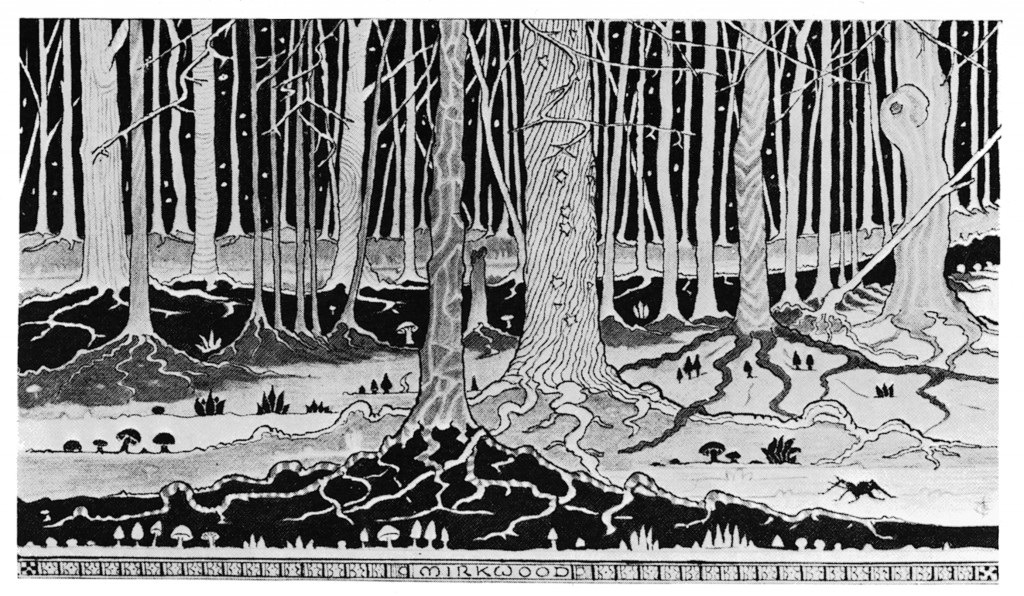
And this was well done, for in the year 1050 of the Third Age there came to the forsaken capital at Amon Lanc a dark power called the Necromancer, and he built there the fortress of Dol Guldur; the Shadow grew deep in Eryn Galen and it became known thenceforth as Taur-nu-Fuin, or Mirkwood in the Annúnaid tongue, and the Emyn Duir are called now the Emyn-nu-Fuin. Fell creatures came to live in our forest and there are rumours of orcs and worse besides around the hill of Dol Guldur; while the Men-i-Naugrim of old lies unused and in disrepair for there are few who pass through Rhovanion now.
Little known is the elf-made path that winds for wellnigh seventy perilous leagues from the Forest Gate on the western eaves of Mirkwood to the Elvenking's Halls, though it was discovered more than seventy years ago by a company of Dwarves wending their way to Erebor in the east. Alas, Thranduil bore also his father's ill will towards Naugrim, for though he counted the Men of the Long Lake as friends, he gave no friendship to Thorin son of Thráin of the House of Durin (for it was he) or his companions; they would not say what cause they had to trespass in his realm, and in his wrath he made them prisoners in the caverns beneath his halls. Their tale is now well known, for they made good their escape from the Woodland Realm, whereafter Esgaroth in Wilderland was brought to ruin by the fire-drake Smaug the Golden, who in turn was slain by Bard the Bowman (now the king of Dale refounded), and the King under the Mountain returned to his seat in Erebor. And in the Battle of Five Armies Elves, Men and Dwarves stood united against the dark might of the orcs and wargs of Ered Mithrin and Hithaeglir; the first field of battle our folk had seen in nigh three thousand years!
Alas that my brother perished on that field ere I ever knew him; though in truth, had he not died I would not have been born! For my mother grieved the loss of her firstborn that left in her heart an emptiness that she could not quell, and that she yearned to fill again with love for a child; and though she carries the weight of many years, her will and desire gave her the strength of being needed for my begetting. But my father's heart misgave him, for the time of the Eldar on Arda is ending and soon will the last set sail from Mithlond and take the Straight Road into the Uttermost West; thus he reasoned it would be unkind to bring a new soul into the Hither Lands, a child whose time herein would be brief by the reckoning of elves... brief and perilous, for the Enemy's Shadow was ever growing across the lands of Middle-earth.
But he hearkened not to his heart's misgiving nor did he gainsay her wish; only to the ear of Echeleb did he voice his doubt, and his father counselled, "Oft hope is born when all is forlorn!" Or so my father tells me, and I wonder often at the meaning of these words. What hope could my birth bring, and for whom? But the renown of Echeleb is for his skill with a bow, not foretelling... perhaps I am troubling my heart overmuch with such thoughts!

 |
1 |
 |