Penned in the House of Healing,
In the Realm of Dorwinion.
In the East I was sorely hurt, but thanks to the skilful care of the Elves (and the qualities of miruvor!), I am now set again on the way to health, and so at last I have been allowed to leave the confines of my bed chamber. For though no house could be fairer than the House of Healing in Dorwinion -- and although Estë the Gentle, Lady of Healing and Rest, is dear to me -- I have now had plenty in the way of rest, and I am weary of lying idle in sloth. And so, weak at first and with faltering steps, I tottered round the verdant gardens that lie hereabout, and beheld a joy of life in the growing things therein that cannot compare to the grim tussocks of the grey plains of Rhûn through which recently I passed.
And it is not only my body that is being made well, for -- though my memory is yet riven asunder -- my nightmares of torment have been replaced by dreams of a fair city of white stone mansions, with silver domes and golden spires, and delicate fountains bound by tree-lined courtyards, alongside graceful stairs of crystal winding gleaming in silver light amidst the celestial music of many bells... and a White Tree. And so I wondered if this is Minas Tirith, the White City of Gondor, that my mind visits in its slumber?
Ioriston deems it is not, for he passed by that place on the road to the royal city of Osgiliath long ere Minas Ithil fell, and it was yet named Minas Anor at the height of its splendour. And even then, he tells me, the Citidal was built as a shield against the wild men of the dales and was a towering bastion of stone, a mighty stronghold. Once more did he see it, after Calimehtar son of Narmacil, thirtieth King of Gondor and defeater of the Wainriders, built the White Tower to house the city's palantír; and long after did Ecthelion I, seventeenth Ruling Steward of Gondor, rebuild the White Tower and enhance its defences, and now in these days it is a formidable hill-fortress. Never has it been as the burnished city of my dreams, and its only domes are those of the white marble tombs of bygone kings and lords.

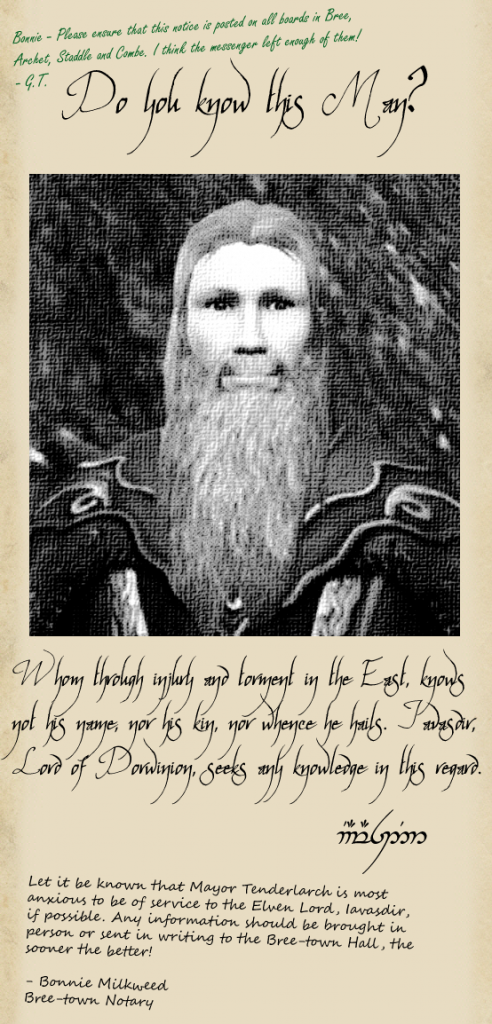 I have learned that besides sending messengers to the North, Lord Iavasdir has sent others to all the cities and townships of Men in Eriador, Rohan and Gondor with a notice bearing my likeness, and a request for tidings should they recognise me. I am beholden to this Elf-lord for his patient endurance and for all that he has done on my behalf, for I am neither his liegeman nor his kin. Though I understand that I arouse his curiosity with my fluent Quenya speech and my chance utterances of the Vanyarin tongue... but how this can be, I cannot tell. Strangely, however long it was that I spent in the realms of the Easterlings -- and thus must have spoken in their own tongue to the Men of Darkness -- I remember naught of their speech. I recall only the loathsome Black Speech of my captors, and the Westron and Sindarin of my fellow thralls in that stronghold of despair that was my prison for so long.
And so this peculiarity is much on my mind of late... for I speak the Sindarin tongue of the Dorwinions, and I oft speak Quenya with Ioriston and Lord Iavasdir (though I am told this was forbidden in the First Age by Elwë Singollo, King of Doriath, who was afterwards called Thingol.) And yet at times within my speech I utter words unbidden that I am told are of a tongue unfound in Middle-earth, that is Vanyarin... and also, says Ioriston, sometimes even words of Valarin! For though he is Úmanyar, many were his kin among the Ñoldor who departed to Aman in the Great Journey during the Years of the Trees, and those exiles taught to him part of the language of the Eldest Speech, the tongue of the Ainur.
But how this can be, I do not know. Perhaps I too, in bygone days, learned from exiled Calaquendi from the Blessed Realm?

| << |
3 |
>> |