The Elves of the Northern Wastes
The bitter cold and harsh terrain of Morgoths former realm is hardly a “natural” setting for Elven habitation. Since the time of their awakening the First Born Chldren of Iluvatar have shunned the Iron mountains and the forbidding regions that lay beyond their cruel peaks. Even the Noldor, indomitable foes of Morgoth shudder with grief and horror when they recall their agonizing passage of the Helcaraxe. Though Morgoth and his realm are long gone, the deathless memory of the Elves remains and few others in Middle Earth would tread willingly upon lands with such evil memories.
Yet there are Elves who, in spite of this stigma, regard Forodwaith as their home. Indeed they hold themselves to be its guardians. Some among them believe their presence in the North was foreordained by the Powers and that, in their labors, they fulfill Ulmos’s desire that the Firstborn ”should be left free to walk as they would in Middle Earth and with their gifts of skill to order all the lands and heal their hurts” (Silmarilion- The Coming of the Elves).
Two very different Elven kindred wander the lands of Forodwith. It was the Noldor who first established a foothold in the North, early on in the Second Age. Isolated from the rest of the World their Hidden refuge endured two ages of the world. Though secretive and few in number, these solitary pilgrims wandered far and wide across the Northern Wastes, pursuing visions and portents, ever seeking to release the slumbering power of the earth, which had for so long slumbered under the icy grip of Morgoth.
The second group to enter Forodwaith were the Snow-Elves. In origin a tribe of Nandor from the south, this Silvan-folk came into the North as exiles, driven from their ancient homeland (so they claimed) by “the tyranny of the Grey”. Reluctant newcomers, they soon proved themselves to be true Nandor, caring more for “tree and herb, bird and beast than all other Elves” (Silmarilion-The Coming of the Elves).
Believing themselves to have entered a place of desolation, they discovered that no malice could utterly stay the Spring of Yavanna, nor hinder the Children of Illuvatar from partaking of its blessings. In time, even the immoderate cold of Morgoth’s ice became their servant, and they would shape this same ice into the Northern refuge of Helcaminasse (Q: Ice City) and other works of great beauty.
The Snow-Elves
The Lossquende (Q: Snow-Elves) still occasionally call themselves by their ancient name of “Teleri”, which numbers them among the last of the three Elven kindred that took part in the great westward march across Middle Earth in the Elder Days. This populous clan became the wellspring for the majority of Elven peoples inhabiting north western Middle Earth. Among themselves, the Noldor label the “Snow-Elves” as “Nandor” (referring to those who never completed the march), but the Snow-Elves do not recognise any such distinction, they are Teleri and take offense at any who would deny it in their presence.
Appearance
The Lossquende are a graceful and beautiful people. Most are extremely fair of skin, with hair ranging from silver to a pale blond; russet tones are uncommon, but not unheard of. Most Lossquende have eyes of blue, though some have shades of amethyst, grey or light green. Both sexes wear their hair long; females usually have braids swept up with carved pins or bands of woven hide.
Much Lossquende clothing is constructed from finely tanned reindeer skin, softer than velvet. Male and female alike wear snug garments that insulate against the icy winds, usually a shirt and vest with breeches; sometimes, a sealskin cloak completes the costume. Males usually wear rounded hats whilst females generally prefer hoods. Boots are made from tougher and thicker hides, laced with rawhide strips. Many of the Elves dye the sinew used for thread with natural materials found from the sea, such as Kelp; this lends a bright, colourful look to their clothing. Ornaments, usually bracelets, rings and dainty buttons, are carved from reindeer antlers into elaborate designs. The Lossquende prize wool and occasionally trade reindeer skins or carved jewellery for bolts of woolen thread or cloth.
Society and Culture
Snow-Elven life has changed little since the founding of Helcaminasse. The concentration of the Lossquende within that walled settlement has brought with it a more hierarchical society, reminiscent of the Noldor or Grey-elven cultures. The governance of this culture comes from a single authority: Losstari, Mistress of the City. Yet the Snow-elves, now as always, are under no compulsion to submit to their lady’s commands; if they choose to abide by their own will only, they are free to depart Helcaminasse’s walls, for a season or permanently, and wander the Northlands at their pleasure.
Even in Helcaminasse the Snow-elves continue to order their lives in accordance with their ancient familial sensibilities, formulating all social relations in the expression of Kinship. In fact many of the “households” of Helcaminasse are formed not by lineage, but by inclination or shared love of some art.
Beyond Helcaminasse’s walls small companies usually form around some charismatic individual, male or female, and their members (except in the case of genuine parents and children) refer to one another as “Brother” and “Sister”.
Though they may be the hardiest of Elves, even the Lossquende must struggle to survive in the uttermost reaches of the North. As no plant life will take root on the Landless Lands; save for the gardens of Losstari, the Snow-elves are forced to turn to a diet of fish and meat. Most Lossquende will supplement this diet with herbs and grains gathered in spring and summer from the Tundra. The wandering companies also tend herds of reindeer in the same manner as the Lossoth and look to these beasts for their transport, milk and horns for adornment. The Lossquende practice good animal husbandry and use weaker animals for food and hides while allowing the best specimens to propagate and improve the herds.

Religion and Worldview
Like all of Iluvatar’s Firstborn Children, the Lossquende are inextricably bound to the life of the world, and the fulfilment of their being can be truly achieved only in the completion of Arda’s own story. Within that tale the Lossquende believe they have a part to play. At first resentful of their exile from the lands of their kinsfolk, the Snow-elves gradually came to believe that their coming to the North was a preordained working of Iluvatar’s will.
The love of the Snow-elves for Ulmo runs deep. Apart from Orome’s visitations in the Elder Days, Ulmo is the only Vala the Lossquende have ever encounted, and his name is ever on their lips as they weave their songs and lays. Like other Elves, the Lossquende hold that in water, “There lives yet the echo of the Music of the Aintur more than in any substance that is in the earth“(silmirillion-Valaquenta), and the spiritual life of the Snow-elves consists primarily in the discernment of that echo. Many a Snow-elf can be found standing alone on some rocky strand, listening to Ulmos’s rhythmic voice amid the lapping waves.
Ice itself the Lossquende refer to as Ulmo’s “frozen voice” whence comes their joy in its shaping. It is believed by the Snow-elves that, in the sculpting of ice by their enchantments, they are bringing to fulfilment the thoughts of Ulmo which he conceived in the Song of Creation. In such labours the Lossquende have become true masters and creators, and by their arts they have transformed Morgoths malice into works of beauty and wonder.
Unlike most Elves, the Lossquende do not desire to depart from Middle Earth into the West. They are drawn by the call of the sea, but since the globing of Arda their faces are turned North rather than West, toward the ever-changing glow of the Northern skies. No other solace do they desire, though they be doomed to fade within the world.
Warcraft
An unwarlike people by inclination, the Lossquende have never cultivated martial powers as a virtue. For the most part, their weapons and skills are orientated towards the hunt. It is true that perils from violence are more numerous in the North than in their ancient woodland homes; but the Lossquende have relied on defence and withdrawal tactics, rather than outright confrontation. The founding of Helcaminasse generated new demands for the concerted defence of fortified walls, and this novelty led to the development of armour as well as new weaponry. The guardians of Helcaminasse don Hauberks crafted from interlocking pieces of ivory, sewn together with whale gut and hardened by a lacquer like coating, the art of making only the Lossquende alone possess.
The Noldor of Oiomúrë
The Vale of Oiomúrë is home to an isolated enclave of Noldorin Elves, mightiest kindred of the Firstborn to remain in Middle Earth and survivors of a small group of refugees fleeing the fall of Eregion, the heavy losses of their unforeseen conflict with the Dragons of The North reduced their number to sixty-six. Since that time, having formed themselves into the Cuiviénen, the “Lodge of Awakening", they have resolutely pursued their heroic quest to heal the wounded land from Morgoths stain.
Appereance
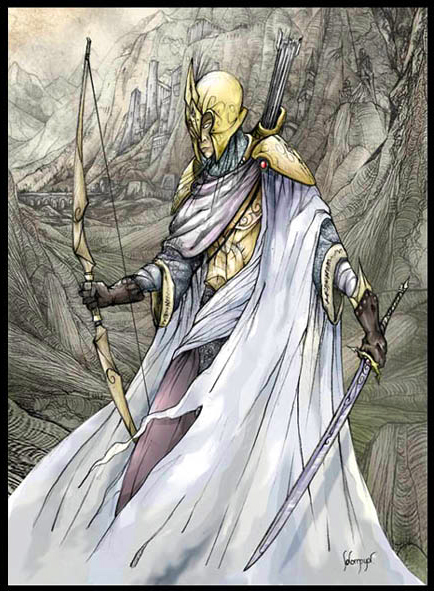
Tall, well-built, dark haired and fair of face, the Noldor are the greatest and noblest of the Free Peoples of Middle Earth. Few of the Noldor of the Forodwaith were born in Valimor, but many of their parents and grand-parents were, and a portion of the power of The Light of the Trees has thus been passed down to them. This gives the Noldor an almost tangible aura. In the refuge of Oiomúrë, kept warm by their enchantments, the Noldor wear practical robes of grey or white embroidered with elaborate designs of stylized plants or animals.
When the Noldor venture away beyond the refuge they wear their thick protective clothing as the cold winds and freezing temperatures are deadly even to the hardiest of races.
Society and Culture
The Noldorian House of Cuiviénen are a small community, largely cut off from the outside world. They were thrown together by fate and led to this blessed place by visions. Many had lost their spouses and families in the escape from doomed Eregion, but some unmarried couples survived their perilous journey. Of the unwed Elves that founded Oiomúrë, most have since married and borne children, but their overall numbers have increased more swiftly than the perils of their quest have claimed them.
The powerful and sometimes divisive sense of kinship that binds the Noldorian society at large is conspicuously absent here. Instead, the Cuiviénen view their fellowship as a clan unto itself, chosen by providence rather than determined by blood. The ritual observances of the Cuiviénen are the outward expression of this sense of adoptive family. The Elves still hold themselves to be vassals of the distant realm of Lindon, serving Gil-gallad in the Second Age and Ciradan in the Third. Ambassadors from the Mithlond are among Oiomúrë’s most frequent visitors.
Religion and Worldview
Though exceptional in its sense of mission and in the circumstances of it’s founding the Cuiviénen stands within a venerable Noldorian tradition of devotional orders. When the Noldor first came to dwell in the Valinor, many among them felt drawn to a particular Vala whose aspect profoundly resonated with the innermost desires of their heart. To this Power they dedicated themselves, as an eager apprentice might join himself to a master craftsman, becoming greater in wisdom and lore in their chosen path than any other of the Children of Iluvatar. Many of these orders followed the Noldorian exiles into Beleriand, and some endured in Middle Earth even after the War of Wrath.
Warcraft
Only very rarely do the few remaining Noldor go to war, but on occasion their guarded refuge may come under attack by fell monsters or far ranging Orc war bands. In the case of a serious threat to the refuge the Elves rely firstly on their formidable array of enchanted wards. These deter the vast majority of intruders. Persistent (or lucky) enemies may make it through the wards only to be overwhelmed by ferocious and highly accurate hidden archers.
On rare occasions, the Elves have despatched a company of warriors to do battle in a more distant place. They have been known to lend aid to those in Forodwaith afflicted by the Witch King’s ire. While few in number, the skill and valour of the Noldor makes them unsurpassed as warriors, whilst their arms and armour out class any other, even the Elves of the South. The smiths of Oiomúrë take great care with their weapons, some of which are millennia old. Although their armour can turn aside most blows from weapons it is still no match for the biting cold of the Forodwaith. For this reason coats of wool and hides are usually worn beneath the ancient armour with a few pieces of especially rare items being made from the hides of the Great Dragons of the North.